Anna Watson
The Girl on the TrainAnna Watson is Tom Watson’s partner and Evie’s mother, but her importance to the story reaches beyond the domestic life Rachel Watson watches from outside. An intimate email exposes Anna’s affair with Tom; later, Anna’s fear of Rachel helps frame Rachel as dangerous, while Rachel’s recovering memory places Anna at the center of a disputed moment on the night Megan Hipwell disappeared.
Identity and Domestic Life
Anna appears in the narrative through her marriage to Tom and her care for Evie. Rachel sees the three of them as a family, and Anna’s life in the home on Blenheim Road becomes an object of painful comparison for her. That domestic picture is not simply a tableau of happiness: it has been built out of the relationship that ended Rachel and Tom’s marriage, and Anna knows that Rachel’s presence can disrupt its sense of safety.
Anna’s account also reveals an earlier, more complicated attitude toward Rachel. When Anna and Tom first began seeing each other, they would meet at a café while Rachel was working in London. Anna remembers the thrill of a possible discovery and admits that she once wanted Rachel to walk in and see that Tom was no longer hers. By the time Rachel appears outside the house, that old fantasy has become an unwanted confrontation.
The Affair and Rachel’s Discovery
Anna’s relationship with Tom is first disclosed to Rachel through his open email account. Rachel had used Tom’s laptop to check his work schedule while secretly planning a fourth-anniversary trip, hoping to make amends for a difficult period in their marriage. She had previously been careful not to snoop, remembering that Tom objected when she answered his phone and accused her of mistrusting him. The discovery therefore begins as an act Rachel understands as affectionate, not investigative.
A message from an account bearing the name Anna Boyd sits at the top of Tom’s inbox. Its reply consists of a row of Xs, which Rachel initially mistakes for spam before recognizing them as kisses. The message answers an email Tom sent shortly after seven that morning, describing his desire for Anna in intimate terms. The exchange establishes the affair that connects Anna to the collapse of Rachel’s marriage; it also makes Anna present in Rachel’s mind before the two women meet face to face.
Fear, Motherhood, and Rachel
Anna’s later view of Rachel is shaped by incidents she experiences as threatening. After Rachel has been seen on Blenheim Road on the night Megan disappears, Anna tells police that Rachel was acting strangely and that she was worried enough to consider calling them. The report places Rachel near Megan’s home around the time Megan left, making Anna an important source in the investigation. Rachel, hearing this account from Detective Inspector Gaskill, is already haunted by an image of herself in the underpass with blood on her hands, though she cannot establish what happened during her memory gap.
Another encounter makes Anna’s fear immediate and physical. She is walking with Tom and Evie in the buggy when Rachel comes out of number fifteen, sees them, and stops. Rachel gives them a strained, unsettling smile; Anna lunges forward and lifts Evie out of the buggy, startling the child into tears. Rachel hurries toward the station as Tom calls after her. Anna’s protective reflex reveals how differently the two women inhabit the same scene: Rachel is fleeing a sight that overwhelms her, while Anna reads her presence as a danger to her child.
Anna connects that encounter to an earlier terror: she remembers seeing Rachel with Evie near the fence and fears Rachel could come into the house and take the child. She also worries about Rachel’s unexplained movements on the night Megan went missing. Anna knows Rachel had been drinking and then vanished; Tom spent a long time looking for her. Although Detective Sergeant Riley reassures Anna that Rachel is merely a lonely onlooker seeking involvement, Anna does not find that explanation sufficient. Her suspicion grows from fear for Evie and from the gaps in Rachel’s story, rather than from any established connection between Rachel and Megan.
The Missing Night and a Contested Memory
Rachel’s account eventually introduces Anna as a possible witness to Tom’s movements that night. When Rachel speaks to Scott Hipwell about Anna and Megan’s relationship, Scott says the women barely knew each other. Rachel then confesses that she thinks she saw Anna outside the underpass by the station on the night Megan disappeared. The admission links Anna to Rachel’s uncertain recollection, but it does not yet explain what Anna was doing there.
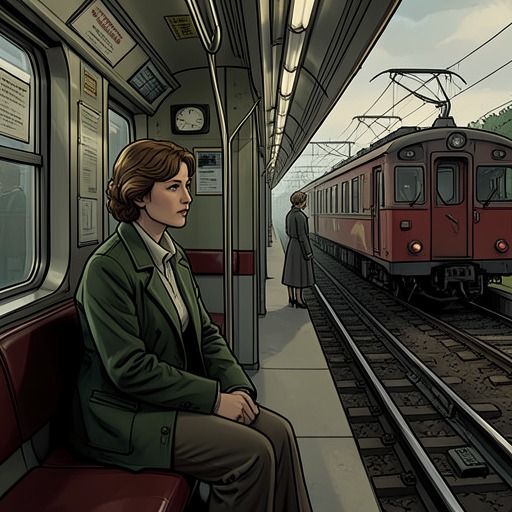
Later, Rachel deliberately returns to the underpass, hoping that revisiting the place might restore her memory. A passing woman in a deep-blue coat prompts a specific image: Anna in a blue dress with a black belt, walking quickly away. In the recollection, Anna looks back and stops; Tom’s red car pulls up beside her, and she speaks to him through the window before getting in. Rachel remembers watching the car drive away. The detail sharply conflicts with what Rachel believes the police told her—that Anna was at home and Tom came looking for Rachel alone. The memory is vivid, but Rachel herself doubts it, and the account leaves its reliability unresolved.
Narrative Role and Significance
Anna is presented first through Rachel’s discovery of the affair, so the reader initially encounters her as the intimate secret behind Tom’s betrayal. Her own recollections complicate that image: she once welcomed the possibility that Rachel might witness her new relationship, but later recoils when Rachel appears and acts decisively to protect Evie. The shift gives Anna a history of desire and rivalry without making her fear in the later scenes any less real.
Her role in the disappearance investigation is similarly double-edged. Anna’s report helps establish Rachel’s presence near Megan’s home, while her anxiety reinforces the suspicion that Rachel may be dangerous. Yet Rachel’s recollection of Anna entering Tom’s car introduces a possibility that unsettles the account of the night without confirming what happened. Anna is therefore both an observer whose testimony affects the investigation and a figure seen through Rachel’s fractured memory. The unresolved tension between those positions makes her central to the novel’s uncertainty about what can be known, and by whom.